The National AI Legislative Framework and the Shadow MCP Crisis
1. National & Sovereign Policy: The White House National AI Legislative Framework
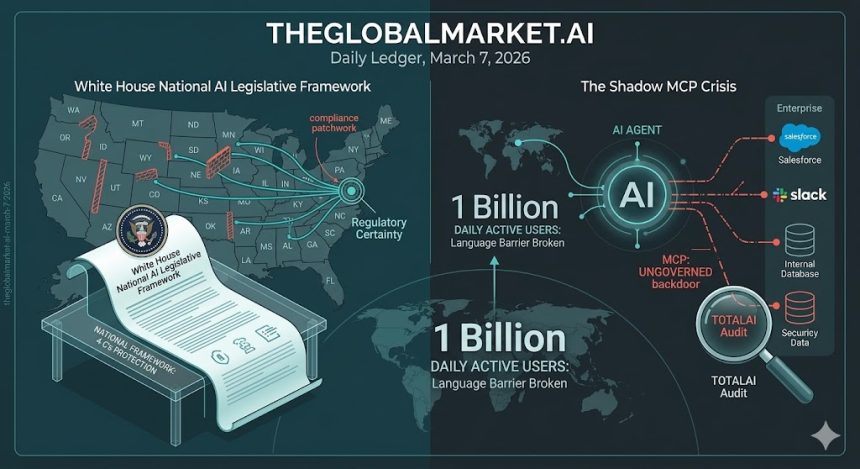
The Event: Building on the momentum of the “Ratepayer Protection Pledge,” the White House officially unveiled the National AI Legislative Framework. This sweeping policy seeks to establish a single federal standard for AI, effectively pre-empting varied state-level regulations.
- The Record: This is a move toward Regulatory Certainty. The framework focuses on the “4 Cs”—protecting Children, Creators, Conservatives, and Communities—while ensuring American companies can innovate without a “compliance patchwork.” It includes streamlined permits for data centers to generate their own power on-site, directly tying AI dominance to energy independence.
- National Impact: By centralizing authority, the U.S. is positioning itself as a unified “Special Economic Zone” for AI. This is a strategic counter to the EU’s more restrictive, fragmented approach, aiming to draw global venture capital back to domestic soil.
2. Enterprise & Market Intelligence: The “Shadow IT” MCP Crisis
The Event: Security researchers at Qualys issued a high-priority alert regarding the rapid, ungoverned adoption of the Model Context Protocol (MCP). MCP has become the “universal adapter” wiring AI agents into enterprise systems like Salesforce, Slack, and internal databases.
- The Record: We are witnessing the rise of AI Shadow IT. While MCP allows agents to act with incredible efficiency, most organizations have “zero visibility” into where these servers are or what data they expose. The protocol that was meant to be a bridge has become a backdoor for unauthorized autonomous actions.
- Business Impact: Enterprises are being forced to pause agentic rollouts to conduct “TotalAI” audits. KODA8 analysis suggests that 2026 will be the year of the AI Firewall, as firms move to govern the “integration tier” sitting between their models and their crown-jewel data.
3. The Global Citizenry: The “Babel” Real-Time Translation Milestone
The Event: Google and Samsung announced that their integrated real-time translation agents, powered by the Gemini 3 architecture, have surpassed 1 billion active daily users across the “Global Citizenry.”
- The Record: The Language Barrier is officially a legacy concept. For the first time in history, over 12% of the world’s population is using AI to communicate across linguistic borders in real-time, from business negotiations to family calls.
- Societal Impact: While this fosters unprecedented global connectivity, it is also triggering a “Cultural Smoothing” effect. As AI standardizes translation, the unique nuances and idioms of local dialects are being replaced by a “Universal Corporate Dialect,” prompting a new movement for the preservation of indigenous linguistic data.
The Archive: March 7, 2026 Summary
Today was the day the “Infrastructure of Trust” was challenged. The U.S. government moved to secure the legal infrastructure through a national framework, while the enterprise world realized that the technical infrastructure wiring its agents together was largely unmonitored. The Record shows that as AI becomes the “Electricity of the Mind,” the primary struggle is no longer its power, but its governance.
Deep Dive Reference
The TRUMP AMERICA AI Act Explained
This broadcast deep-dives into the legislative friction between federal preemption and state rights that defined the news cycle for March 7th.
As we document the historical record for March 7, 2026, the focus turns to the “American AI Framework” and the “Shadow IT” crisis. This was the day the U.S. moved to pre-empt a patchwork of state laws in favor of a unified national strategy, while enterprise security teams scrambled to map the hidden connections wiring AI into their core infrastructure.
This is the THEGLOBALMARKET.AI Daily Ledger, powered by KODA8.