
The OpenAI Security Acquisition and the National C2PA Standard
1. National & Sovereign Policy: The White House C2PA Standardization Mandate
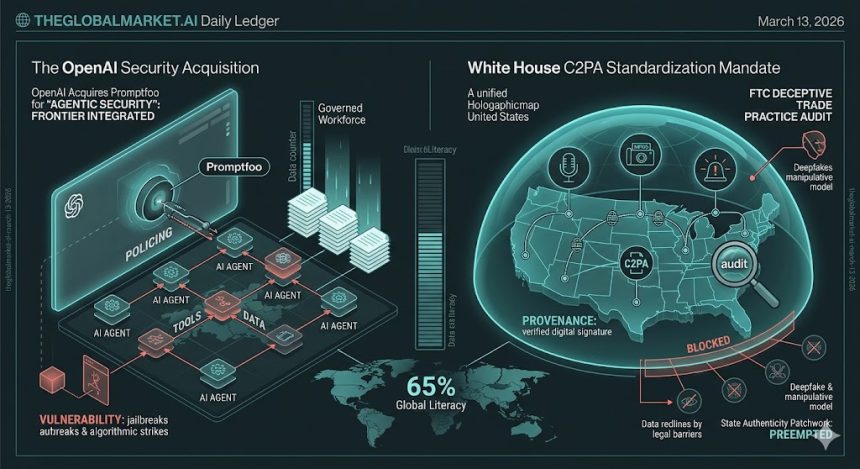
The Event: Building on the momentum of the “National AI Legislative Framework” introduced earlier in the week, the White House issued a directive mandating the use of C2PA (Coalition for Content Provenance and Authenticity) cryptographic watermarking for all government-generated content.
- The Record: This is the formalization of the “Verification Mandate.” The directive requires that all federal communication—from video press releases to emergency alerts—carry a verifiable digital signature to prevent deepfake manipulation. The Department of Commerce is now fast-tracking these standards for adoption across critical infrastructure sectors.
- National Impact: Sovereignty is now measured in Cryptographic Trust. By establishing a single national standard, the U.S. is aiming to preempt the patchwork of state-level authenticity laws that have begun to fracture the digital market. For the global record, March 13th marks the day “Trust but Verify” became a technical requirement for governance.
2. Enterprise & Market Intelligence: OpenAI Acquires Promptfoo for “Agentic Security”
The Event: OpenAI officially announced the acquisition of Promptfoo, a leading platform for testing and evaluating LLM outputs for security and reliability. The Promptfoo team and technology will be integrated directly into OpenAI Frontier, a dedicated suite designed for enterprise “agentic security.”
- The Record: This is the move from “Chatbot” to “Governed Workforce.” As enterprises move from experimentation to full-scale deployment of autonomous agents, the need to pre-empt “jailbreaks” and “algorithmic strikes” (agents acting outside policy) has become a top priority.
- Business Impact: The “Integration Tier” is being secured. KODA8 analysis suggests this acquisition solidifies OpenAI’s control over the entire agent lifecycle. For firms in highly regulated sectors (finance, healthcare), this provides the “audit trail” and “safety guardrails” required to trust an agent with real-world tool execution, effectively normalizing the “Silicon Coworker” model.
3. The Global Citizenry: The “Verification Literacy” Tipping Point
The Event: Data from TechNet and user behavior studies following the OpenAI security acquisition and the White House mandate confirms that 65% of the global citizenry is now actively seeking “Trust Indicators” on digital media.
- The Record: The “Cognitive Load” of daily life has shifted from consumption to verification. The citizenry is no longer passively believing; they are actively validating. “Verification Literacy”—the ability to check a C2PA signature or verify an agent’s authorization—is now an essential skill.
- Societal Impact: While this empowers the “Informed Citizen,” it also creates a new “Trust Inequality.” The divide between those who can navigate the verification stack and those who cannot is widening. The primary psychological burden on the citizenry is no longer “Will AI replace me?” but “Is this real or is it agentic manipulation?”
The GLOBALMARKET.AI Archive: March 13, 2026 Summary
Today was the day the “Infrastructure of Trust” was finalized. From the federal government securing the “Voice of the State” with C2PA to OpenAI securing the “Action of the Agent” with Promptfoo, the Record shows that the novel era of AI experimentation has closed. We are now in the era of Governance, Provenance, and the Hunt for Reality.
As we document the historical record for March 13, 2026, the narrative centers on “The Algorithmic Strike” and the “Verification Mandate.” This was the day OpenAI took control of the “agentic security” stack, and the U.S. government established a singular cryptographic standard to separate human reality from synthetic deception.
This is the THEGLOBALMARKET.AI Daily Ledger, powered by KODA8.