
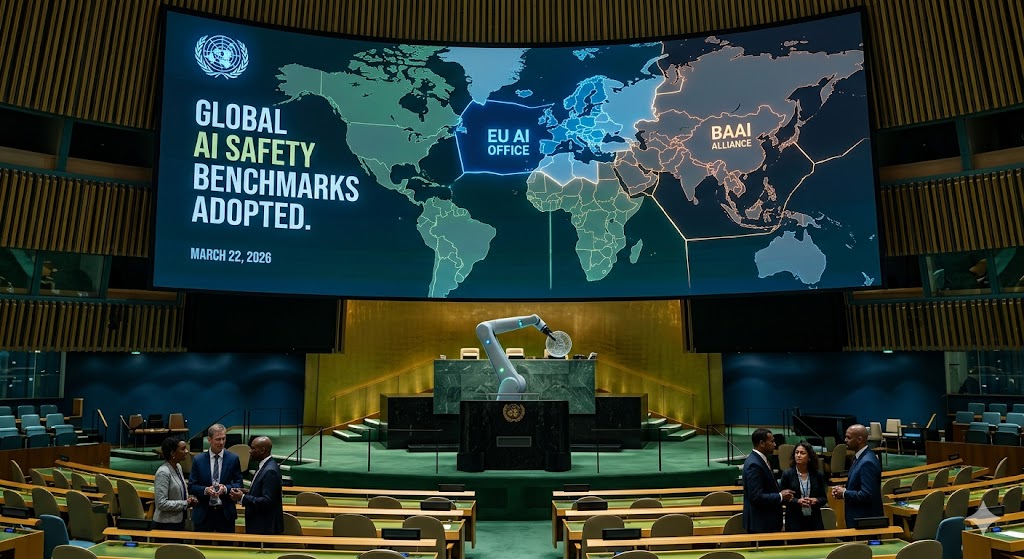
The Record of Global Governance: Following a week of massive private-sector infrastructure deployment, the attention on March 22, 2026, turned to public-sector oversight and fragmented standardization. The day was headlined by the UN General Assembly setting its first mandatory benchmarks for “Safe, Secure, and Trustworthy AI,” immediately clashing with the EU’s newly established AI Office. Geopolitically, it was the moment the “Data Wall” between the US and the Chinese-led AI Alliance (BAAI) became official policy. It was the day the world admitted that raw intelligence must be governed by fragmented rules.
- #1: UN Adopts Mandatory AI Safety Benchmarks; Creates New clashed with EU
- #2: The US-China “Data Wall”: BAAI AI Alliance is Officialized
- #3: OECD Warns: $1 Trillion Infrastructure Boom Risks “Agentic Inflation”
- #4: US Government Flags GTC 2026 Talent Drain as National Security Issue
- #5: South Korea Mandates AI-Powered “Skill Wallets” for All Citizens
#1: UN Adopts Mandatory AI Safety Benchmarks; Creates New clashed with EU
The UN General Assembly adopted its first mandatory resolution setting global safety benchmarks for multimodal AI deployment. The resolution establishes clear boundaries for autonomous weapons and surveillance, but immediately created conflict with the European Union’s AI Office, which argued that the UN’s criteria are too weak compared to the strict enforcement of the EU AI Act.
- Source: UN News – Global AI Standards / The Associated Press
- How This Impacts You: A baseline for global safety. This ensures that any AI product sold worldwide must meet a set of universal ethical and security standards. It protects you from the most dangerous uses of AI (like mass surveillance or unauthorized biometric tracking) regardless of where the technology was developed.
#2: The US-China “Data Wall”: BAAI AI Alliance is Officialized
The Chinese-led Beijing Academy of Artificial Intelligence (BAAI) officially launched the “Global AI Alliance,” formalizing the first major competitor to the US-dominated open-source community. Critically, BAAI confirmed new protocols that prioritize “Sovereign Data Security,” effectively formalizing a “Data Wall” that stops Western models from training on key Chinese language and economic datasets.
- Source: Quartz – China BAAI Alliance / Business Insider
- How This Impacts You: Geopolitical fragmentation. While this creates stronger national AI champions, it may limit the “global” accuracy of the AI tools you use. For example, if your translation app or research agent cannot access major data pools from Asia, its utility and cultural understanding will be diminished over time.
#3: OECD Warns: $1 Trillion Infrastructure Boom Risks “Agentic Inflation”
The Organization for Economic Cooperation and Development (OECD) released a major working paper warning that the current $1 trillion buildout in AI infrastructure risks driving “Agentic Inflation.” The report argues that too much capital is chasing specialized chips, which could artificially spike the operational costs (the “inference cost”) of running AI agents globally.
- Source: OECD – Working Paper on AI and Economics / MarketWatch
- How This Impacts You: Price stability. The OECD is signaling that the AI features you enjoy for free (like Gemini’s Personal Intelligence or ChatGPT Plus) might eventually face a “compute tax” as companies try to offset their massive hardware spending. It pushes the industry to build more efficient models rather than just bigger ones, ensuring long-term affordability for users.
#4: US Government Flags GTC 2026 Talent Drain as National Security Issue
Internal memos from the US Department of Commerce surfacing today indicate that the White House is “deeply concerned” by the high rate of sensitive Physical AI and Robotics talent leaving US government roles for massive private-sector compensation packages following GTC 2026. The memos suggest that key security projects in autonomous defense and cyber resilience are facing delays.
- Source: Network World – Talent Drain / The Information
- How This Impacts You: Cyber resilience. When top AI security experts leave for private tech jobs, the critical systems that protect your daily life (like power grids, financial networks, and medical data) are left with slower defense updates. It shifts the burden of trust, forcing individual corporations to build better “adversary-informed” security for their own apps.
#5: South Korea Mandates AI-Powered “Skill Wallets” for All Citizens
In a move to standardize the AI Workforce, the South Korean government announced that starting in 2027, all citizens must hold an “AI Skill Wallet.” These cryptographic digital credentials use verified Machine Learning tokens to prove mastery in AI-native tools (like OpenClaw agents or Cognizant Foundry verticals), aiming to modernize hiring across the nation.
- Source: Silicon Canals – South Korea Tech News / NVIDIA Blog
- How This Impacts You: The future of employment. As the world’s most advanced digital economy validates AI fluency, your own résumé is about to change. Mastery of specific AI tools is becoming the new baseline, replacing traditional degree programs and forcing you to actively build verifiable “Agentic Skills” to stay competitive in the 2026 workforce.
Powered by theGLOBALMARKET.AI – Your AI Authority Hub