Humanoid Service Debuts and the Sovereign Supply Chain Crisis
1. National & Sovereign Policy: The Pentagon’s “Supply Chain Risk” Designation
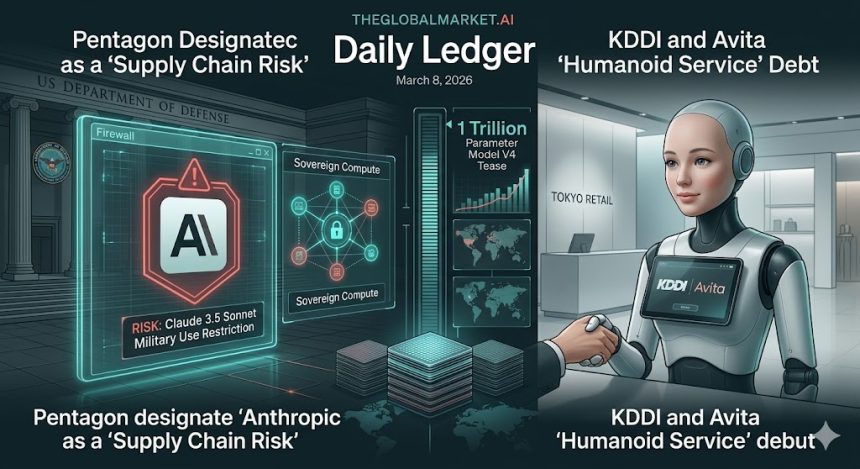
The Event: Following a tense standoff over military usage, the U.S. Department of Defense formally designated Anthropic as a “Supply Chain Risk.” This follows the startup’s repeated refusal to remove safety guardrails that prohibit the use of its Claude models in autonomous weaponry and kinetic military operations.
- The Record: This is a historic clash between Corporate Ethics and National Security. The designation effectively blacklists Anthropic from federal defense contracts, marking the first time a major AI lab has been penalized by the state for its alignment policies.
- National Impact: This move accelerates the “Sovereign AI” divide. Nations must now choose between “Safety-First” models and “Mission-First” models. For the global record, this signals that the White House National AI Framework will increasingly treat AI labs as strategic defense utilities rather than independent software vendors.
2. Enterprise & Market Intelligence: DeepSeek V4 “Trillion-Parameter” Tease
The Event: DeepSeek released a technical preview for V4, a massive 1-trillion-parameter multimodal model. Crucially, the model was trained entirely on domestic Chinese silicon (Huawei and Cambricon), bypassing the need for restricted NVIDIA or AMD hardware.
- The Record: This is the “Hardware Independence” milestone. It proves that high-frontier intelligence can be manufactured outside the Western silicon monopoly. Simultaneously, Anthropic has publicly accused DeepSeek of “Industrial-Scale Data Distillation,” alleging the model was trained using synthetic data stolen from Western frontier models.
- Business Impact: The market is bracing for a “Pricing War.” If DeepSeek can deliver trillion-parameter intelligence at a fraction of the cost of Western models, it threatens the high-margin API business of OpenAI and Google. KODA8 analysis suggests 2026 will be the year of “Compute Arbitrage” for global enterprises.
3. The Global Citizenry: KDDI and Avita “Humanoid Service” Launch
The Event: In a major push for “Embodied AI,” Japanese telecom giant KDDI and robotics firm Avita announced a partnership to deploy humanoid service robots across retail and hospitality sectors in Tokyo.
- The Record: Japan is officially deploying the “Silicon Workforce” to combat its labor shortage. Unlike previous generations of robots, these are powered by low-latency edge AI, allowing for natural, empathetic customer interactions in real-world environments like reception desks and museums.
- Societal Impact: For the global citizenry, the “Uncanny Valley” is becoming a daily utility. This marks the transition of AI from a digital assistant on a screen to a physical presence in the community. As these “Digital Citizens” take up space in the physical world, the conversation shifts from “Screen Time” to “Physical Trust.”
The Archive: March 8, 2026 Summary
Today was the day the “Invisible” became “Physical.” Whether it was the Pentagon demanding control of the cloud’s ethics or a robot greeting you at a Tokyo storefront, the Record shows that AI is no longer a guest in our software—it has become a citizen of our world and a weapon of our states.
As we document the historical record for March 8, 2026, the narrative focuses on “Embodied Intelligence” and the “Supply Chain Standoff.” This was the day AI stepped out of the cloud and into physical service roles, while the geopolitical friction between private ethics and state military power reached a historic boiling point.
This is the THEGLOBALMARKET.AI Daily Ledger, powered by KODA8.