AI Language Models

What is a Large Language Model (LLM)?

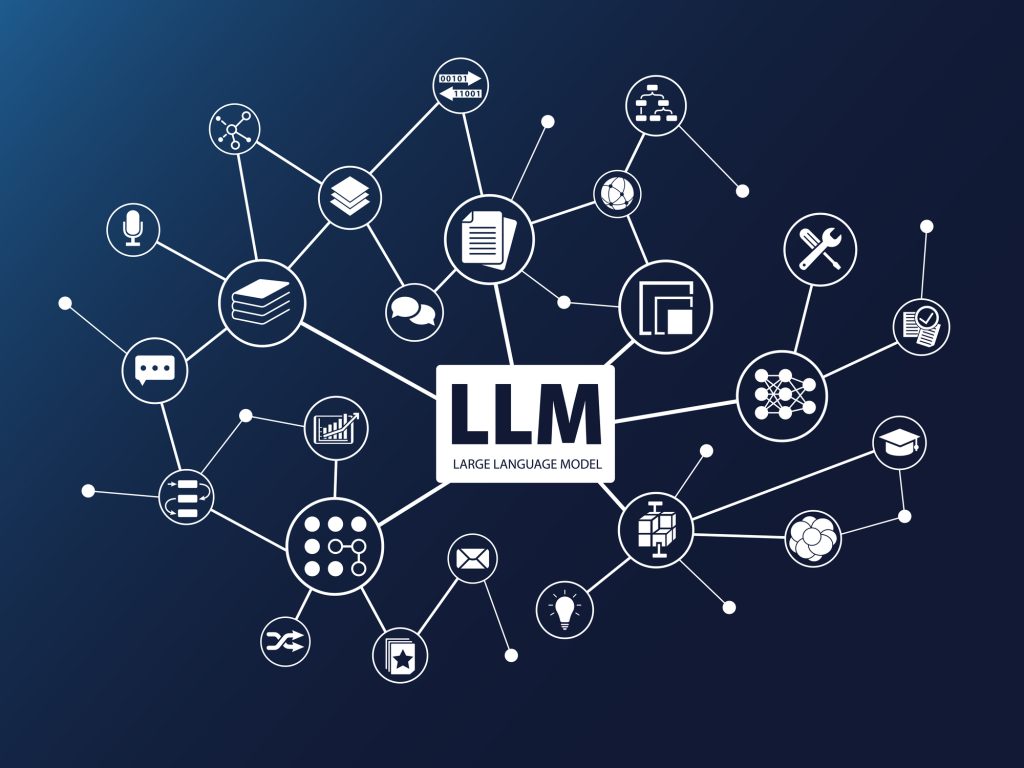
A Large Language Model (LLM) is an advanced artificial intelligence system, typically based on deep learning architectures like transformers, trained on massive datasets of text (and increasingly multimodal data like images or audio) to understand, generate, and predict human-like language. These models excel at tasks such as conversation, translation, summarization, coding, and reasoning by processing billions or trillions of parameters—essentially the “neurons” that learn patterns from data. Unlike traditional rule-based AI, LLMs learn probabilistically, predicting the next word or token in a sequence based on context.

The term “LLM 2025” likely refers to the state of LLMs as of 2025, a year marked by explosive growth, multimodal capabilities, and a shift toward efficient, open-source models. The global LLM market is projected to surge from $6.5 billion in 2024 to $140.8 billion by 2033, driven by adoption in 92% of Fortune 500 companies for workflows like automation and chatbots. By 2025, an estimated 750 million apps will integrate LLMs, automating 50% of digital work.

Key Trends in LLMs for 2025

  • Multimodality: Many LLMs now process text alongside images, video, or audio, evolving into Large Multimodal Models (LMMs). This enables applications like visual question-answering or image captioning.
  • Efficiency and Open-Source Boom: Smaller, cost-effective models outperform larger ones on specific tasks, with open weights allowing customization. Training costs are dropping—e.g., some models trained for under $6 million.
  • Reasoning and Agentic AI: Models increasingly “think” step-by-step (e.g., via chain-of-thought prompting) and act autonomously, like coding agents or multi-step planners.
  • Democratization and Ethics: Broader access via open-source reduces vendor lock-in, but challenges include bias, energy demands (e.g., natural gas advocacy for powering data centers), and impacts on human skills like writing.
  • Applications: From clinical workflows (e.g., documentation automation) to neuroscience predictions, LLMs are outperforming experts in niche areas.

Top LLMs in 2025

Here’s a comparison of leading models based on parameters, key features, release timing, and strengths. Selections focus on accessible, high-performing options for general use.

Model Developer Parameters Key Features Release Date Strengths
Grok-3 xAI Undisclosed (frontier-class) Reasoning-focused, “scary smart” for complex tasks; competes with GPT-4o. February 2025 Multimodal reasoning, efficiency in coding/STEM.
Gemini 2.5 Pro Google Undisclosed “Deep Think” mode for step-by-step reasoning; native multimodal (text/image/video). March 2025 Complex problem-solving, translation in 100+ languages; cost-effective.
DeepSeek-V3-0324 / R1 DeepSeek 671B (R1) Open-weight, low-cost operation; comparable to OpenAI o1 in reasoning. March 2025 (V3), January 2025 (R1) Affordable training ($5.5M), high performance on benchmarks.
Llama 4 Meta 123B 128K context window; supports 80+ coding languages and dozens of natural languages. April 2025 Open-source versatility, multilingual tasks.
Claude Sonnet 4 Anthropic Undisclosed Agentic coding (e.g., terminal integration); excels in business/STEM. May 2025 Transparent, reliable for developers; strong in conversation.
Mistral Large 2 / Medium 3 Mistral AI 123B (Large) Mixture-of-Experts (MoE) for efficiency; multimodal (Pixtral variant). July 2024 (Large), May 2025 (Medium) Scalable for NLP/multimodal; open weights for research.

Phi-4 Series

Microsoft 3.8B–14.7B Small but outperforms larger models; MIT-licensed for commercial use. Early 2025 Edge deployment (runs on laptops); reasoning variants.
Qwen 3 Series Alibaba 4B–72B Supports 100+ languages; tool-calling integration. 2025 (ongoing) Multilingual, efficient for apps; strong in translation.
Command A Cohere Undisclosed Specialized variants (Vision, Reasoning, Translate); outperforms on business tasks. 2025 Domain-specific (e.g., 23-language translation); enterprise-focused.

These models represent a mix of proprietary (e.g., Gemini) and open-source (e.g., Llama) options. For coding, Claude Sonnet 4 or Mistral Large shine; for general use, Grok-3 or Gemini 2.5 Pro lead in versatility.

Future Outlook

By late 2025, expect more agentic models (e.g., Google’s rumored multi-step AI) and evaluations pitting LLMs against human experts in fields like psychology and medicine. While transformative, LLMs still face hurdles like hallucinations and ethical deployment—prompt engineering and fine-tuning remain key to reliability. If you’re building with LLMs, start with open-source like Llama 4 for flexibility.

Latest AI Language Models News

What are the top 10 travel destinations that everyone should visit in their lifetime according to ChatGPT?

PROMPT: You are the the greatest travel advisor ever. What are the…

What are the top 10 travel destinations that everyone should visit in their lifetime according to DeepSeek?

As the self-proclaimed "greatest travel advisor ever," I've curated a list of…

Sign In

Register

Reset Password

Please enter your username or email address, you will receive a link to create a new password via email.