



The Ratepayer Protection Pledge and the Disciplined March to Value
1. National & Sovereign Policy: The White House “Ratepayer Protection Pledge”
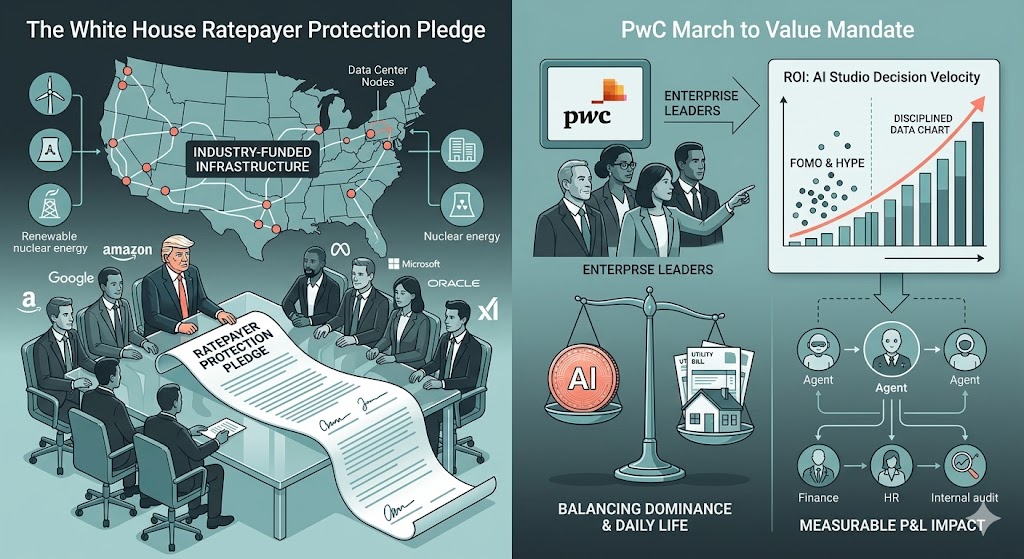
The Event: President Trump convened the leaders of the world’s largest tech firms—including Amazon, Google, Meta, Microsoft, OpenAI, Oracle, and xAI—to sign the Ratepayer Protection Pledge.
- The Record: This is a definitive shift toward “Industry-Funded Infrastructure.” The pledge mandates that hyperscalers must build or buy their own new power generation and cover 100% of the transmission upgrades required for their data centers.
- National Impact: This policy prevents the “AI Tax” on the global citizenry. By ensuring that massive energy demands do not drive up residential electricity bills, the administration is protecting the middle class while simultaneously fast-tracking nuclear and advanced energy permits for the “Winning the Race” action plan.
2. Enterprise & Market Intelligence: The PwC “March to Value” Mandate
The Event: PwC released its 2026 AI Business Predictions, signaling the end of “exploratory” AI spending. The report highlights a shift from ground-up, crowdsourced AI projects to top-down, leadership-driven “AI Studios.”
- The Record: The “Easy Money” era of LLM experimentation is over. In 2026, enterprise success is defined by Decision Velocity—how quickly a company can automate complex decision trees using Agentic AI.
- Business Impact: The market is bifurcating. Companies that treat AI as a “feature” are falling behind those building “AI-Native Platforms.” The focus has moved from “impressive adoption numbers” to P&L-impacting workflows in finance, HR, and internal audit.
3. The Global Citizenry: The “Disinformation Security” Gap
The Event: As AI adoption reaches a tipping point in everyday life—from Siri’s new Gemini-powered “On-Screen Awareness” to Samsung’s AI-driven smart appliances—a new “Trust Gap” has emerged in the 2026 Global Human Capital Trends report.
- The Record: For the first time, “Verification Literacy” has become a more valuable skill than “Content Creation.” As AI becomes “Invisible Infrastructure” embedded in every device, the global citizenry is struggling to distinguish between autonomous agent actions and genuine human intent.
- Societal Impact: We are entering the era of Context Engineering. For the average person, the challenge is no longer using the tech, but framing problems correctly and verifying the AI-generated outputs. “Trust but Verify” has moved from a geopolitical slogan to a daily digital survival requirement.
The Archive: March 4, 2026 Summary
Today was the day the “AI Bill” was settled. The U.S. government ensured tech giants—not citizens—paid for the power grid, while the business world stopped chasing “shiny objects” and started demanding real-world benchmarks.