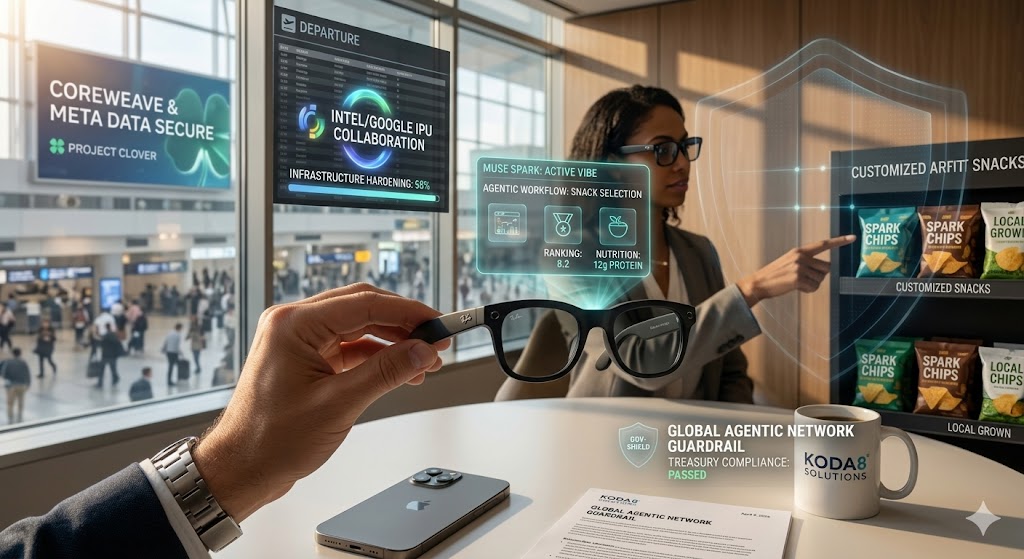

The Record of “Strategic Hardening”: Thursday, April 9, 2026, was defined by “Infrastructure Hardening.” The day was headlined by Meta’s massive $21 billion cloud agreement with CoreWeave to secure long-term compute through 2032 and Intel’s deep collaboration with Google to build custom “IPU” chips that offload the heavy lifting of AI networking. Simultaneously, Meta officially released its first multimodal powerhouse in a year, Muse Spark, signaling a pivot toward “Personal Superintelligence” that can see and act on the real world. It was the day the AI industry moved from “growth at all costs” to “stability at scale.”
- #1: Landmark Move: Meta & CoreWeave Ink $21B Infrastructure Pact
- #2: The Efficiency Pivot: Intel & Google Co-Develop Custom “IPUs”
- #3: Model Release: Meta Unveils “Muse Spark” Multimodal Power
- #4: Data Sovereignty: TikTok Commits Another €1B to Finland
- #5: Legal Guardrails: Whoop vs. Bevel Trade Dress Battle Escalates
#1: Landmark Move: Meta & CoreWeave Ink $21B Infrastructure Pact
In a massive show of force for the AI Infrastructure market, Meta Platforms and CoreWeave announced a long-term, $21 billion agreement extending through 2032. The deal secures dedicated AI cloud capacity across multiple global locations, including early deployments of the NVIDIA Vera Rubin platform, to scale Meta’s massive inference workloads for its 3 billion+ users.
- Source: CoreWeave Newsroom – April 9, 2026
- How This Impacts You: AI that stays fast. As billions of people start using AI Agents for daily tasks, the “Inference Lag” could break the experience. This deal ensures that Meta’s services—from Instagram’s Muse Spark to WhatsApp’s business agents—stay near-instant, reliable, and capable of handling the most complex requests without slowing down.
#2: The Efficiency Pivot: Intel & Google Co-Develop Custom “IPUs”
Intel and Google Cloud announced a multiyear collaboration to advance the next generation of data center architecture. The partnership centers on co-developing custom ASIC-based Infrastructure Processing Units (IPUs) designed to offload networking, storage, and security tasks from the main CPUs, freeing up more “effective compute” for Agentic AI Workloads.
- Source: Intel Newsroom – April 9, 2026
- How This Impacts You: Lower costs and higher reliability. By moving “boring” background tasks to these specialized IPUs, Google Cloud can run AI systems much more efficiently. For you, this means more stable cloud services and potentially lower pricing as the physical backbone of the internet becomes optimized specifically for intelligence, not just data.
#3: Model Release: Meta Unveils “Muse Spark” Multimodal Power
Meta’s Superintelligence Labs officially released Muse Spark, a new multimodal model built for “Personal Superintelligence.” Unlike standard LLMs, Muse Spark is designed with strong visual perception, allowing it to identify objects in photos, rank nutritional data on airport snacks, or help style a room by “looking” at your surroundings via AI glasses.
- Source: Meta Newsroom – April 8/9, 2026
- How This Impacts You: AI that “looks” with you. This isn’t just a chatbot; it’s an eyes-on assistant. For your theglobalmarket.ai properties, this signals a future where content creation isn’t just about text, but about an AI that can “see” and interact with your products and the real-world environments they live in.
#4: Data Sovereignty: TikTok Commits Another €1B to Finland
Continuing its Project Clover initiative, TikTok (ByteDance) confirmed a second €1 billion investment in a data center in Lahti, Finland. The facility is part of a broader €12 billion European data sovereignty push, designed to store European user data locally under strict independent oversight by the NCC Group.
- Source: TikTok Newsroom – April 7/9, 2026
- How This Impacts You: Digital privacy goes local. This investment confirms that the era of “Global Data Slush Funds” is over. For users, it means your personal digital footprint is increasingly protected by the specific laws and Governance Shields of your own region, rather than being subject to the rules of a foreign headquarters.
#5: Legal Guardrails: Whoop vs. Bevel Trade Dress Battle Escalates
The wearables market hit a major legal milestone as Whoop escalated its lawsuit against AI health coach Bevel. The case, which covers trademark and patent infringement, is being closely watched as a defining test for “UI Trade Dress” in the AI era—essentially asking if a company can own the “look and feel” of how health data is displayed.
- Source: Reddit / bevelhealth – April 9, 2026
- How This Impacts You: Protection for innovation. If Whoop wins, it will be harder for small AI startups to “wrap” existing data in a similar interface. It highlights the importance of Original Research over simple UI mimicry in the Personal AI Health space.
Powered by theGLOBALMARKET.AI – Your AI Authority Hub