




The Regulatory Relapse : Silicon Valley Blocks the Gavel while Anthropic Turns a Profit
Making the Future Familiar.
- The Regulatory Relapse : Silicon Valley Blocks the Gavel while Anthropic Turns a Profit
- #1: Last-minute Silicon Valley pressure forces White House to cancel AI Executive Order
- #2: Anthropic projects massive $10.9 Billion Q2 revenue, achieving first-ever profitability
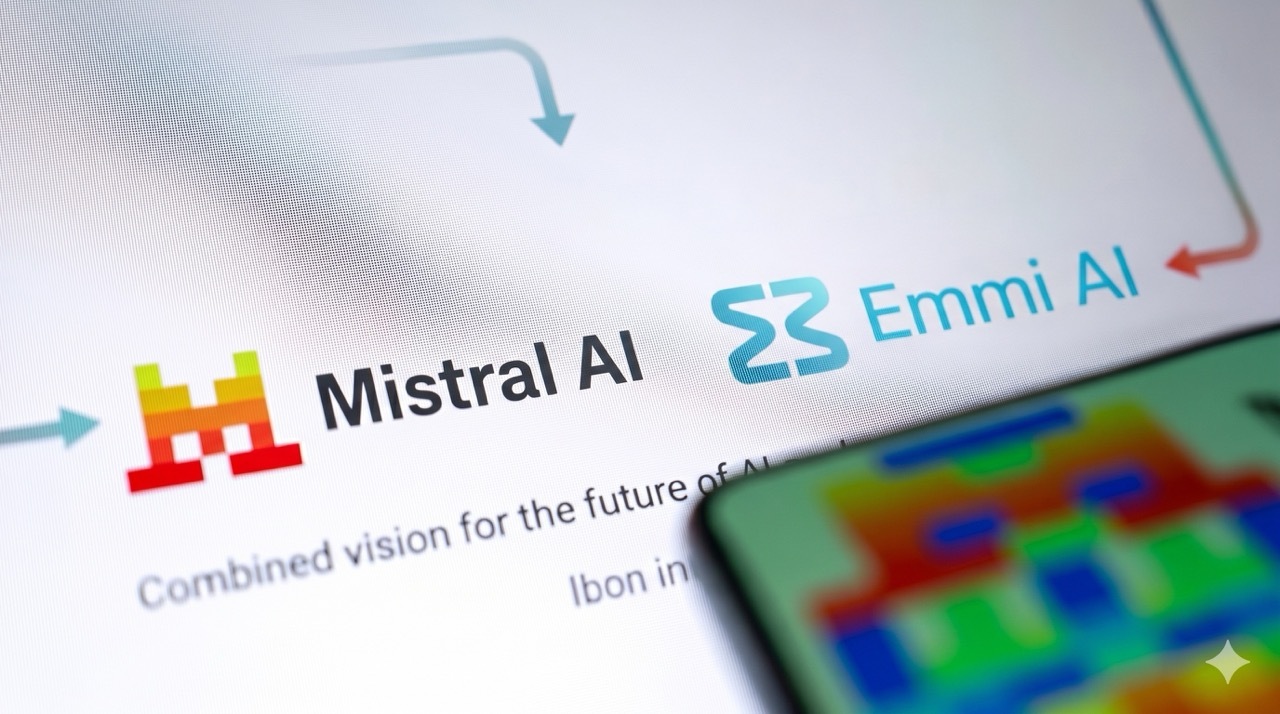
- #3: Mistral AI acquires Emmi AI to embed fundamental physics into autonomous systems
- #4: NPR sounds the alarm on Google’s new search box as an “Extinction-Level Event” for publishers
- #5: New York enacts strict digital budget ban on 3D-printed firearms files
AI is no longer just answering questions. It is rewriting the structural boundaries of global regulation while achieving unprecedented commercial and operational self-sufficiency. Today’s Daily AI Ledger tracks five foundational, whiplash-inducing shifts: Silicon Valley’s block of a major White House AI Executive Order, Anthropic’s historic $10.9 billion revenue velocity, and a major acquisition bridging the gap between large language models and fundamental physics.
The KODA8 Glossary:
- The Manual Tax: The exhausting, high-friction bureaucratic overhead—such as manual compliance filing, voluntary pre-clearance tracking, and multi-day industrial physics computations—that autonomous networks are dissolving.
- Sovereign Logic: Your defensive command over your own systems, ensuring your operational roadmap and proprietary data structures are governed by internal business logic rather than fluctuating government protocols or black-box tech monopolies.
#1: Last-minute Silicon Valley pressure forces White House to cancel AI Executive Order
In a stunning late-night development, President Donald Trump blocked a highly anticipated, sweeping Executive Order on artificial intelligence just hours before its scheduled announcement. Intense, eleventh-hour lobbying from tech leaders—including Elon Musk, Mark Zuckerberg, and former AI czar David Sacks—convinced the administration that a proposed voluntary 90-day pre-clearance vetting regime would create a de facto mandatory licensing barrier, severely stunting American innovation against international competitors.
- Source: The Washington Post – May 22, 2026
- How This Affects Your Business: The regulatory floor remains an unmapped open market. Businesses have a wide open window to scale, deploy, and experiment with advanced agentic networks without navigating heavy, multi-month federal pre-clearance overhead or governmental permissions.
- How This Affects Your Privacy & Security: The lack of federal vetting keeps the burden of safety entirely on you. With models like Anthropic’s Mythos displaying advanced capabilities to autonomously uncover and exploit security flaws in computer code, exercising Sovereign Logic to lock down your internal data boundaries is non-negotiable.
- Bottom Line: Silicon Valley successfully blocked the government’s attempt to install a pre-clearance checkpoint on code deployment.
#2: Anthropic projects massive $10.9 Billion Q2 revenue, achieving first-ever profitability
Anthropic shared internal financial projections with investors revealing the most explosive revenue trajectory in AI history: $10.9 billion in revenue for the single quarter ending in June 2026, up 130% from Q1. Defying all industry expectations, the company projects an operating income of $559 million, marking the first-ever quarterly operating profit for a frontier-level AI lab.
- Source: Build Fast with AI – Q2 2026 Financial Analysis
- How This Affects Your Money: The myth that frontier AI models are purely loss-making money pits is dead. Anthropic’s soaring annualized run rate—jumping from $9 billion at the end of 2025 to a projected $43.6 billion by June—proves that corporate enterprise adoption of tools like Claude Code is generating massive, recurring profit margins.
- How This Affects Your Job: Enterprise infrastructure budget allocation is permanently shifting. Because Anthropic’s compute-to-revenue ratio fell from 71 cents down to 56 cents, companies are aggressively moving capital away from general software subscriptions and directly toward automated developer agents.
- Bottom Line: The enterprise market has picked its winner; automated, code-level execution is now a highly profitable, self-sustaining industry.
#3: Mistral AI acquires Emmi AI to embed fundamental physics into autonomous systems
European AI leader Mistral AI announced a definitive agreement to acquire Physics AI pioneer Emmi AI. The strategic move combines Mistral’s open, enterprise models with Emmi’s state-of-the-art “large engineering models,” allowing AI agents to understand physical space, model real-time simulations, and build complex digital twins for heavy industrial environments.
- Source: Mistral AI Research & Newsroom – May 22, 2026
- How This Affects Your Business: For operators in manufacturing, aerospace, and automotive logistics, multi-day engineering computations are transitioning to real-time simulations. You can deploy specialized agents to optimize asset operations and test product design cycles under physical constraints instantly.
- How This Affects Your Job: The separation between digital software and heavy industrial engineering has blurred. Industrial professionals must move beyond traditional CAD drafting and learn to govern generative twins that predict physical wear and structural strain autonomously.
- Bottom Line: AI is moving past textual analysis and logic; it is actively learning to process and predict the rules of the physical world.
#4: NPR sounds the alarm on Google’s new search box as an “Extinction-Level Event” for publishers
Following Google’s massive I/O overhaul of its core search engine interface earlier this week, publishers, media houses, and independent web property owners are bracing for severe economic fallout. Industry experts speaking on NPR warned that the shift to conversational, background-executed “Information Agents” threatens to starve traditional websites of organic traffic.
- Source: NPR: All Things Considered – May 22, 2026
- How This Affects Your Money: The traditional consumer monetization web is breaking. When an AI agent performs due diligence, fetches pricing data, and proposes products behind the scenes without the user ever clicking an external link, classic ad-driven and affiliate business models face systemic collapse.
- How This Affects Your Business: Digital visibility requires a complete architectural pivot. To prevent traffic extinction, your digital properties can no longer rely on superficial keyword matching; they must serve as high-authority repositories of verifiable factual ground truth that machine agents are forced to reference.
- Bottom Line: Search has evolved from an index of links into a closed destination loop, making direct brand authority your only viable shield.
#5: New York enacts strict digital budget ban on 3D-printed firearms files
As part of its Enacted State Budget, New York implemented aggressive new public safety provisions targeting the “plastic pipeline” of untraceable firearms. The legislation explicitly criminalizes the manufacture of 3D-printed ghost guns, silencers, and magazines, while completely banning the sale, distribution, or digital transmission of the data files used to print them.
- Source: New York State Assembly Press Office – May 22, 2026
- How This Affects Your Kids & Community: Local enforcement is locking down digital code as physical contraband. The law mandates the creation of a specialized technological working group to evaluate the feasibility of mandatory “blocking technology” built directly into the firmware of 3D printers sold within the state.
- How This Affects Your Privacy: This establishes a heavy legal precedent for hardware-level monitoring. If firmware-level blocking technology becomes mandatory, it opens long-term privacy concerns regarding how deeply manufacturing devices must continuously scan and log local files to verify compliance.
- Bottom Line: State governments are realizing that in an digital era, code is the blueprint for real-world hardware, and they are regulating the file transfer layer directly.
The bottom line: The theme of May 22, 2026, is structural autonomy. While Silicon Valley successfully kept the federal government from installing checkpoints on code deployment, Anthropic proved that the commercial market is generating billions in cash to fund the next frontier. The sandboxes are gone. From Mistral modeling the laws of physics to New York regulating the transmission of digital blueprints, value is shifting entirely to those who wield Sovereign Logic—the independent architects who control the data, the code, and the underlying files.
Powered by theGLOBALMARKET.AI — Making the Future Familiar.